
The Discerning Leader — An AI Integration Series
Organizations today are investing heavily in AI, yet the results often fall short of expectations. Despite billions of dollars flowing into enterprise GenAI initiatives, many companies are still struggling to translate that investment into measurable value.
A 2025 MIT report on generative AI adoption highlights a striking reality: a vast majority of organizations see little to no return from their GenAI efforts, despite large-scale spending. MIT’s 2025 GenAI Divide report Meanwhile, a separate study by McKinsey’s 2025 State of AI survey paints a similar picture—AI adoption is widespread, but enterprise-level financial impact remains limited.
The question is no longer whether organizations are using AI. They are. The real question is why so few are seeing meaningful transformation from it.
This series explores that gap—and more importantly, what it actually takes to close it.
The gulf between AI spending and AI value
Across industries, AI has moved rapidly from experimentation to enterprise deployment. Most organizations now report using AI in at least one business function. Yet, despite this widespread adoption, only a fraction are seeing consistent, organization-wide gains.
The pattern is becoming clear:
- AI is widely deployed, but often shallowly integrated
- Tools are introduced, but workflows remain unchanged
- Experiments are run, but systems are not redesigned
- Usage increases, but productivity impact stays uneven
In other words, AI is present—but not yet embedded.
The core issue is not model capability or regulatory barriers. It is how organizations approach integration itself. Too often, AI is layered on top of existing processes rather than being designed into the structure of work.
The result is predictable: fragmented workflows, limited context awareness, and minimal operational change.
What successful integration actually looks like
To understand what works, it helps to look at how high-performing organizations behave differently.
In practice, successful AI integration is rarely top-down or platform-first. Instead, it is grounded in the realities of day-to-day work.
One innovation leader at a major automotive company described a deliberately gradual approach. Rather than deploying an enterprise-wide AI system and expecting immediate transformation, he worked team by team.
He started by observing how work actually moved—where delays happened, where information got lost, and where people relied on manual effort or informal knowledge to keep things running. Only after understanding these patterns did he begin building tools tailored to each workflow.
Crucially, he stayed involved after deployment—iterating based on feedback and refining the tools until they reduced measurable friction. Only then did he move on to the next team.
The outcome was not just better tools. It was trust, adoption, and measurable efficiency gains rooted in real operational needs.
This approach reflects a simple but often overlooked principle: AI delivers value when it is designed around work, not imposed on it.
The first principle: listen for friction
Before any AI system is designed or deployed, there is a more important task: understanding where work is already breaking down.
This is what we call listening for friction.
It means stepping into teams and paying attention to how work actually happens—not how it is documented or supposed to happen, but how it functions in reality.
Friction shows up in predictable ways:
- Time lost waiting for information or approvals
- Repeated manual work that could be automated
- Fragmented tools that do not communicate
- Context that lives only in people’s heads
- Workarounds that exist because systems fall short
These are not minor inefficiencies. They are signals. Each one points to an opportunity where AI may be able to reduce cognitive load, streamline execution, or eliminate unnecessary steps.
The key is not to assume where AI will help—but to observe where work is already struggling.
Six questions that surface meaningful opportunities
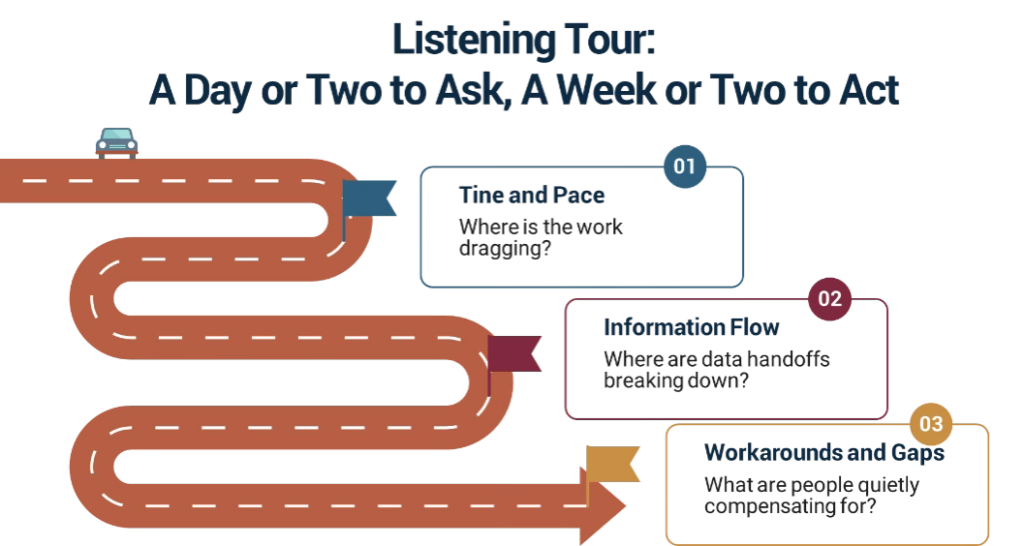
A structured listening tour helps turn observation into insight. The goal is not to gather opinions, but to identify patterns of friction across teams.
Six questions are especially effective:
1. Time and place
- Where does work slow down?
- Where do people consistently lose time?
2. Information flow
- Where does information become fragmented?
- Where do handoffs break between teams or systems?
3. Workarounds and gaps
- Where do teams rely on memory, manual effort, or “heroics”?
- Where is critical context difficult to access when needed?
These questions are simple, but the answers are revealing. They highlight not just inefficiencies, but structural gaps in how work is supported.
Within a short period of observation and conversation, patterns begin to emerge that point directly to high-impact intervention areas.
How much listening is enough?
There is a temptation to treat discovery as a large-scale exercise: map every team, document every process, and build a comprehensive picture before acting.
But in practice, this often slows momentum without improving outcomes.
A more effective approach is incremental:
Start with a few non-customer-facing teams. Identify friction. Build small, targeted solutions. Observe the impact. Learn how the organization responds to change.
Then expand.
This creates a feedback loop between observation and implementation—one that builds both credibility and internal understanding of what actually works.
Importantly, it also preserves trust. Teams are far more likely to engage when they see that their input leads to tangible improvements, not just documentation.
What comes next
Identifying friction is only the first step. Not every inefficiency is a good candidate for AI, and not every pain point should be automated.
The next challenge is prioritization: understanding which frictions AI can meaningfully reduce, and which ones require different kinds of organizational change.
In Part 2: From Long List to First Round, we will explore how to filter insights from a listening tour into actionable priorities—and how to identify the opportunities where AI can deliver real, measurable impact.