
An open invitation to higher education deans
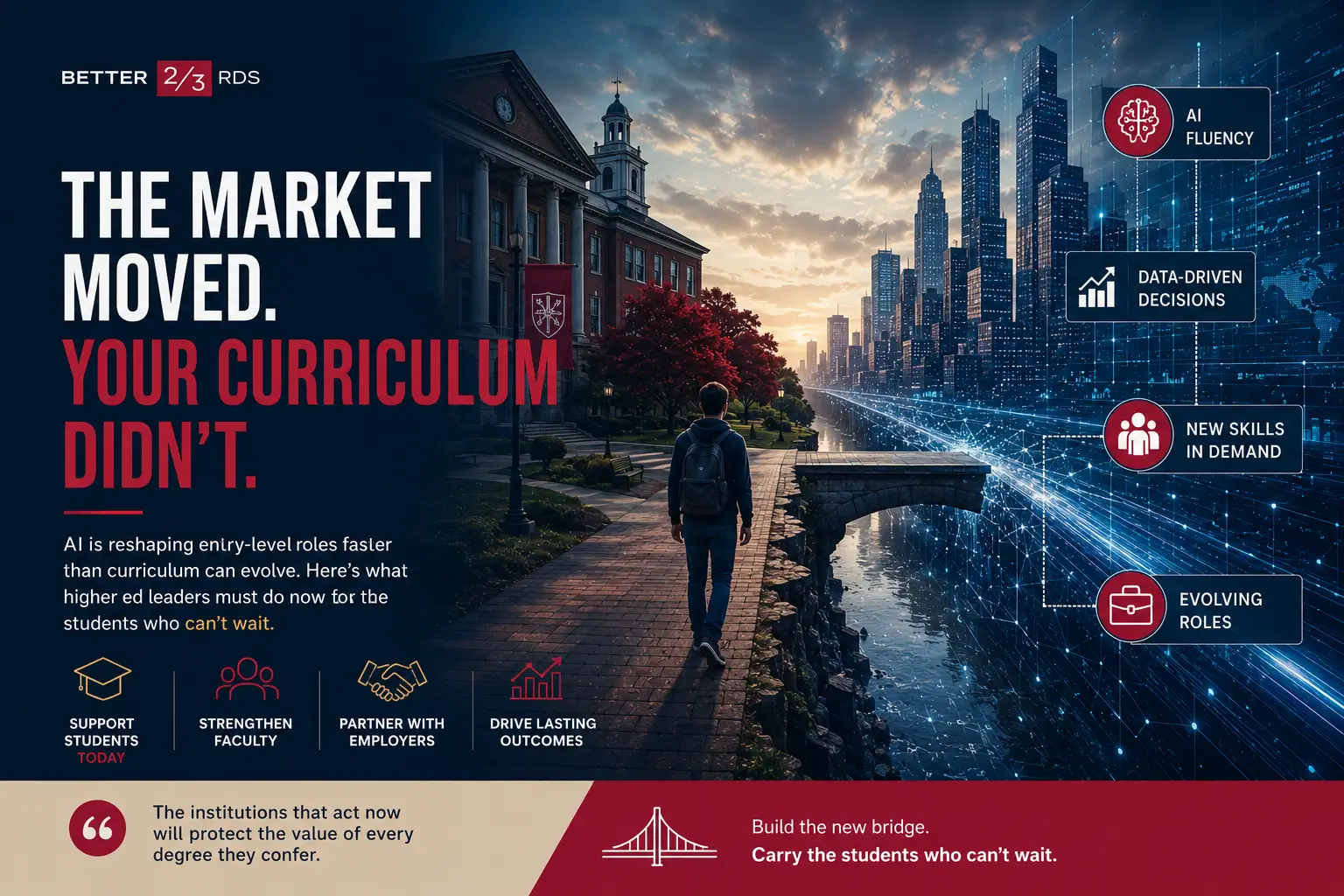
There is an old story about a town that kept building the same bridge in the same place, long after the river beneath it had changed.
The bridge was not a failure. It was, by any structural measure, a triumph. Sound engineering. Quality materials. The craftspeople were proud of it, and they should have been. For generations, the bridge did exactly what a bridge is supposed to do: it connected the people on one bank to the opportunity on the other. You built your programs on one side. The labor market waited on the other. Your graduates crossed. The system worked.
Then the river changed.
Not a flood. Not a collapse. The current simply shifted, the way rivers do when something fundamental changes upstream. The channel widened. The water moved faster. And a bridge that was built for a narrower crossing must reach farther than its original specifications anticipated.
That river is AI. And it is still rising.
You already know this. The work is underway on your campus. Task forces have been convened, program reviews are in motion, faculty committees are drafting revisions, and pilot courses are running. A new bridge is being designed. I am not writing to tell you to start. I am writing because the new bridge, done well, on schedule, will open three to four years from now. And the students walking across campus this week graduate before it does.
That is the real problem.
A long-term curriculum revision, executed rigorously and on time, still lands the students currently enrolled in a market that has already moved on. The class of 2026 does not get the revised curriculum. Neither does 2027. Neither, in most programs, does 2028. They get whatever the institution can put in place right now, layered onto what already exists. Finishing the revision on schedule is not the frame, because there is no “on time” on a revision timeline for the students who are already there.
The long-term work is necessary but insufficient. What is missing is the short-term and mid-term work that meets current students where they are. This includes faculty development that changes next semester’s syllabus by embedding AI fluency modules in existing courses, co-curricular credentials that stack onto degrees already in progress, and employer partnerships that shape capstones and internships this academic year. That is the work that holds the value of the degree for the students who cannot wait for the new bridge to open.
Employers are quietly reconfiguring entry-level roles, precisely the ones your graduates are counting on for their first foothold. They are not announcing it. They are not issuing press releases. They are simply restructuring job descriptions, adding AI fluency requirements, eliminating tasks that can be automated, and raising the baseline expectation for what a new hire should be able to do independently on day one. When those roles change shape or disappear, the degree that was supposed to open the door starts losing its pull. Rankings and employer perception follow. And once that shift takes hold, you know as well as I do how difficult it is to walk back.
The families sitting across from your admissions counselors this year have already started doing the math. A 2024 Gallup and Lumina Foundation survey found that only 36 percent of Americans have strong confidence that a four-year degree is worth the cost, down from 53 percent a decade ago, and that was before the AI layoffs started. They have been told for decades that a college degree is worth roughly one million dollars more in lifetime earnings than a high school diploma. But that calculation looks different when it is sitting behind an average of $37,000 in student loan debt, interest accruing from the semester it is taken out, in a market where 42.5 percent of recent graduates are working in jobs that do not require a college degree. Degree devaluation is happening in real time, and it is attaching to institutional names quietly, for now.
So, what is your team doing for the students who graduate before the new curriculum is in place?
You know your people. Your faculty are subject matter experts who have spent careers going deep in their disciplines. Your staff are hard workers who keep complex institutions running under relentless pressure. They are smart. They are capable. They are already building the long-term bridge. The river has not outrun them. What they need is not replacement or reinvention. They need the short-term and mid-term supports that carry current students across while the new bridge is still under construction.
The leadership this moment requires is structural. Your faculty bring deep disciplinary expertise that no AI system replaces. Your staff keep complex institutions running under relentless pressure. Their knowledge is valid, their contribution is real, and this work is additive to everything they have already built. What the moment calls for is a deliberate investment in the infrastructure that serves students now, protects the value of degrees already in progress, and strengthens what your institution stands for: its reputation, its outcomes, and the long-term value of every degree it confers.
Beyond those interventions, the institution itself needs three structural supports: AI fluency standards embedded in current program outcomes, faculty development that changes what happens in classrooms next semester, and employer partnerships that deliver market signal before it becomes a headline. These are the supports that carry current students across the gap while the curriculum revision does its longer-term work. These are the commitments that keep the crossing intact as the river rises.
Curriculum and the AI-enabled labor market sit on opposite banks. AI is the widening river between them. Your new bridge is being built. The three supports are what carry the students who cannot wait for it to open.
The institutions that invest in those supports will hold the value of their degrees across every graduating class, not just the ones who benefit from the revised curriculum years from now.
Relying only on long-term curriculum revision is a gamble. As you get it together, your peer institutions climb the ranks. They deliver a stronger case for leadership that met this moment. Their graduates’ families feel certain the investment was worth the debt. The bridge your team is building is worth finishing. The students crossing right now are worth carrying.